What Is EBOO Therapy? What It Does and What It Does Not Do
A plain guide to how the machine works, what the research shows, where the FDA stands, and who should not have it.
EBOO is a treatment some clinics offer. You may have seen photos of dark blood running through a tube. This guide explains what the machine does. It also explains what the research does not show.
We offer ozone-based care at EverVive, so you should weigh what we say with that in mind. We have tried to write the page we would want a family member to read.
What is EBOO therapy?
EBOO stands for extracorporeal blood oxygenation and ozonation. Extracorporeal means “outside the body.” That is the whole idea in three words.
A machine takes blood out of one arm. It mixes ozone gas and oxygen into the blood. Then it returns the blood to your other arm. The blood never leaves the tubing. It moves in a loop.
You may also see it called EBO2 or ozone dialysis. These names describe the same kind of treatment.
How the EBOO machine works
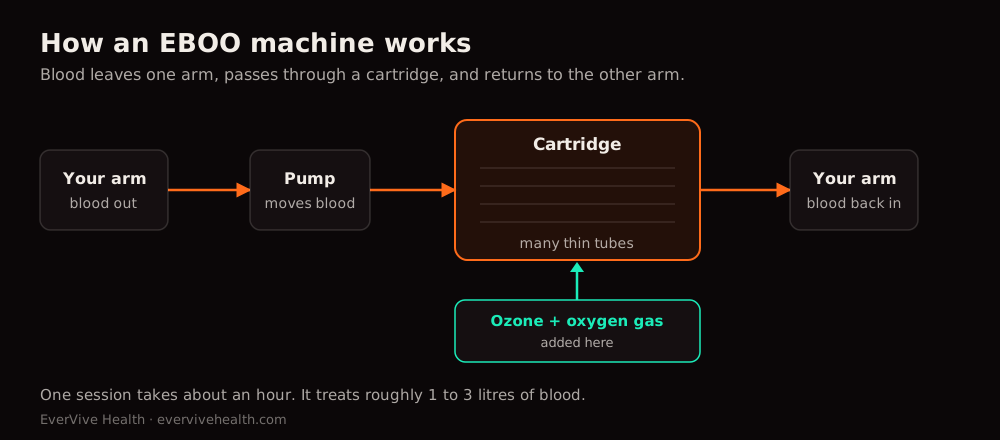
The parts are simple. A needle goes in each arm. A pump moves the blood. In the middle sits a plastic cartridge.
The cartridge holds hundreds of very thin tubes. Blood flows past them. Ozone and oxygen pass through the tube walls and mix into the blood. A drug is added so the blood does not clot in the tubing.
A session takes about an hour. Clinics treat roughly 1 to 3 litres of blood. Your body holds about 5 litres in total.
Does the cartridge filter toxins out of your blood?
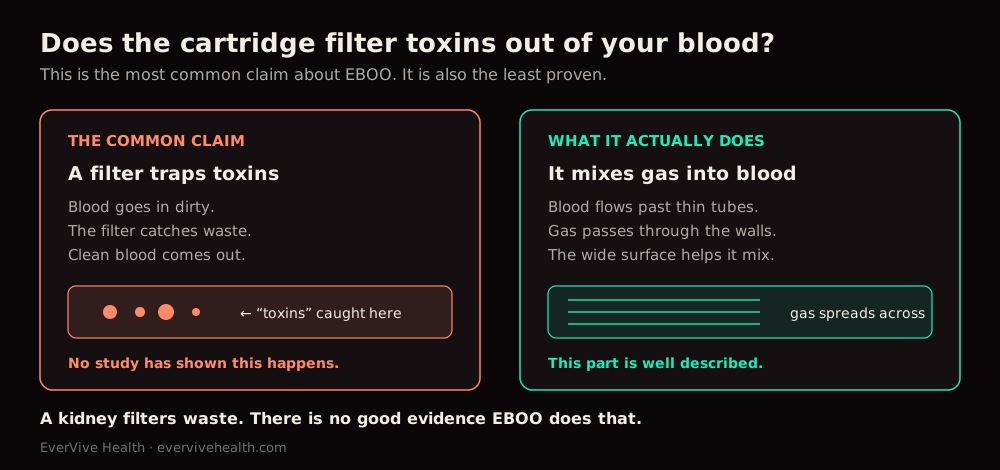
This is the most common claim you will read about EBOO. It is also the weakest one.
Many clinics say the cartridge cleans waste out of your blood. Some show you dark material and call it toxins. No published study has shown that this happens.
Here is what can be said. The cartridge is built to mix gas into blood. The thin tubes give the gas a wide surface to cross. That is a mixing job, not a cleaning job.
The nickname “ozone dialysis” comes from the shape of the cartridge. It looks like a kidney dialysis filter. A kidney filter removes waste from blood. EBOO has not been shown to do that.
If a clinic tells you it pulls toxins out, ask one question. Which test proved it?
Why the blood looks dark
Dark blood is used in a lot of EBOO marketing. It is worth knowing why blood looks that way.
Blood in your veins is always dark red. It carries less oxygen. When it meets oxygen it turns bright red. This happens in every healthy person.
So dark blood in a tube is not a sign that you are ill. And blood turning brighter is not proof that a treatment worked. It only shows that oxygen was added.
How EBOO differs from other ozone treatments
Ozone is used in several ways. The difference is how much blood is treated at once.
- Major autohemotherapy. A bag of blood is drawn, mixed with ozone, and dripped back. It treats about 200 millilitres at a time.
- Ten-pass ozone. The same idea, repeated ten times in one visit.
- EBOO. Blood moves in a loop through a machine. It treats about 1 to 3 litres in one hour.
So EBOO handles far more blood. That is the main selling point you will hear. But treating more blood has not been shown to produce a better result. Volume and benefit are not the same thing.
What the research shows
The honest answer is: very little, so far.
There is one small controlled trial. It was published in 2005 and included 28 people with poor blood flow in the legs. Skin sores healed better in the EBOO group. But blood flow in the limb did not improve in either group.
Most of the other EBOO research comes from the same Italian team. No other team has repeated their results. A 2026 review of ozone research looked at many studies. It did not find strong evidence for EBOO at all.
Writers who are critical of the treatment, such as Science-Based Medicine, point out that it has barely been tested in healthy people. That is a fair point, and we link to it so you can read it yourself.
So there is no good evidence that EBOO treats long Covid, Lyme disease, mould illness, autoimmune disease, or ageing. You will see all of those claims online. They are not supported.
Is EBOO FDA approved?
No. This matters, so here it is plainly.
Ozone is not approved by the FDA to treat any illness. An FDA rule describes ozone as a toxic gas with no known useful medical use.
In July 2025 the FDA sent a warning letter to a company that makes EBOO machines. The letter said the machines did not have the approval they needed.
Some clinics say their equipment is “FDA cleared.” That is not the same as the FDA approving the treatment. It is worth asking what they mean.
Who should not have EBOO
Some people should not have this treatment at all.
- People with G6PD deficiency. Their red blood cells break down more easily.
- People who are pregnant or breastfeeding.
- People with bleeding or clotting problems.
- People with heart disease that is not stable.
- People with very low platelets or recent heart attacks.
A G6PD blood test should be done before a first session. If a clinic does not offer that test, treat it as a warning sign.
Side effects people report include tiredness, headache, feeling sick, and bruising where the needles went in. More serious harms have been reported with ozone treatments in general, though they appear to be rare.
What a session is actually like
We wrote a separate guide to the visit itself. It walks through screening, the lines, monitoring, and recovery, step by step.
Read it here: what happens during an EBOO session.
If you are considering it, our EBOO therapy page sets out how we run a session at our clinic in Jacksonville Beach and who we will not treat. You can also read how we think about regenerative care more broadly, and why we publish the limits of what we offer.
Questions people ask
What does EBOO stand for?
EBOO stands for extracorporeal blood oxygenation and ozonation. Extracorporeal just means “outside the body.” Some clinics call it EBO2 or ozone dialysis.
Is EBOO therapy FDA approved?
No. Ozone is not approved by the FDA to treat any illness. An FDA rule calls ozone a toxic gas with no known useful medical use. Some clinics say their machine is “FDA cleared.” That is not the same thing.
Does EBOO filter toxins out of your blood?
There is no good study showing that it does. The cartridge is built to mix gas into blood. A kidney filters waste. EBOO has not been shown to do that job.
Why does the blood look dark?
Blood in your veins is always dark red. It has less oxygen. It turns brighter when it meets oxygen. Dark blood is normal and is not a sign of illness.
How long does an EBOO session take?
The machine usually runs for about an hour. The whole visit often takes 60 to 90 minutes.
How much does EBOO cost?
Prices vary a lot between clinics, and insurance does not cover it. Ask any clinic for the full cost of a course, not just one session.
Who should not have EBOO?
People with G6PD deficiency should not have it. Nor should people who are pregnant or breastfeeding, people with bleeding problems, or people with unstable heart disease. Ask for a G6PD blood test first.
Is EBOO the same as other ozone therapy?
No. Other ozone treatments handle a small amount of blood at once. EBOO runs blood through a machine in a loop and treats much more.
Does EBOO hurt?
Most people feel the two needles going in. After that it is usually painless. Some people feel tired or get a headache afterwards.
How to decide
You do not need to decide from a web page. Ask a doctor who will tell you when something is a poor fit.
Three questions are worth asking any clinic. What evidence supports this for my problem? What is the full cost of a course? And will you test my G6PD first?
If you want that conversation with a physician, including the reasons not to go ahead, we are happy to have it.
About this article. This is educational information, not medical advice, and it is not a substitute for assessment by a qualified clinician. EBOO is not FDA-approved, and the published human evidence for it is limited. Nothing here describes a guaranteed outcome. Last reviewed 14 October 2026.